Title: Analyzing the Challenges and Shutdown Dynamics of Kirana
Shops in Urban Colonies: A Comprehensive Study of Retail Management Issues
Abstract: This paper aims to analyze the key factors responsible for
the decline and shutdown of Kirana (neighborhood) shops in urban colonies,
focusing on retail management issues. Based on primary data collected from
customers and shop owners through structured surveys, the study incorporates
SPSS analysis to uncover underlying patterns. Critical retail challenges
identified include selling products above MRP, expired or poor-quality goods,
cash flow problems, limited digital payment acceptance, incorrect quantity practices,
poor customer communication, dual pricing systems, and the sale of illegal or
unauthorized products such as eggs in restricted areas. The findings are
essential for policymakers, retail strategists, and local governance to rethink
the sustainability of small-scale retail in urban India.
Keywords: Kirana shops, Urban retail, SPSS analysis, MRP violations,
expired goods, digital payments, retail shutdown
1. Introduction
Kirana shops have long been the
backbone of Indian retail, offering personalized services and essential goods
to local residents. However, with the rise of organized retail, e-commerce
platforms, and changing consumer preferences, these small, often family-run
businesses face significant survival challenges. Particularly in urban
colonies, Kirana shops are either shutting down or transitioning into other
forms of retail. This research investigates the core management and operational
issues that contribute to the vulnerability and eventual closure of these
shops.
Literature Review
Kirana shops, the ubiquitous
neighborhood retail outlets across Indian urban colonies, have long been the
backbone of the informal retail sector. Known for their personalized service
and community-centric approach, they significantly contribute to employment and
local economies (Kumar & Singh, 2012; Rao, 2016). However, the past decade
has seen an accelerating trend of closures among these stores due to mounting
challenges from organized retail, digital platforms, economic volatility, and
regulatory burdens. This literature review critically examines research from
2009 to 2025, focusing on operational dynamics, shutdown causes, and areas
needing further academic inquiry.
1.
Overview of Kirana Shops
Kirana shops typically offer
groceries, household items, and personal care products. Their informal yet
highly adaptive business model provides deep community integration (Srinivasan
& Kaur, 2015; Rao, 2016). Despite their small scale, they form a
substantial part of India's urban retail landscape (Kumar & Singh, 2019),
reflecting entrepreneurial resilience in the face of economic and
infrastructural limitations.
2.
Key Challenges Faced by Kirana Shops
a.
Competition from Organized Retail and E-Commerce
The proliferation of supermarkets,
malls, and e-commerce platforms such as Amazon and Flipkart has significantly
altered the competitive landscape. Organized retailers leverage scale for
better pricing, variety, and promotional strategies (Sharma & Gupta, 2018).
Digital players offer convenience and doorstep delivery, reducing footfall in
kirana stores (Joshi & Mehta, 2020).
b.
Supply Chain Inefficiencies
Kirana shops often rely on
fragmented supply networks and local wholesalers, leading to inconsistent
inventory and delayed restocking (Verma & Sinha, 2021; Joshi et al., 2020).
This hampers customer satisfaction and restricts competitiveness.
c.
Regulatory and Policy Constraints
Licensing, tax compliance, zoning
laws, and other bureaucratic hurdles limit the operational flexibility of small
retailers (Sharma, 2019; Singh & Verma, 2021). These challenges consume
time and financial resources, pushing many shopkeepers into informal or
non-compliant modes of operation.
d.
Technological Disruption
The inability to adopt digital
payment systems, point-of-sale tools, and inventory software places kirana
shops at a technological disadvantage (Mehta, 2022). While some retailers are
attempting to bridge this gap via apps and fintech partnerships, digital literacy
remains a challenge.
e.
Economic Volatility and Inflation
Thin profit margins make kirana
shops highly susceptible to inflation, rising rental costs, and economic
downturns. The COVID-19 pandemic served as a tipping point for many businesses,
causing a surge in permanent closures (Srinivasan, 2021; Rao & Reddy,
2023).
3.
Shutdown Dynamics of Kirana Shops
a.
Financial Fragility
Many shops operate without financial
buffers, making them vulnerable to even minor economic shocks. Studies show a
high dependency on daily sales for operational continuity (Gupta & Rani,
2022).
b.
Changing Consumer Preferences
Urban consumers—particularly the
younger generation—are gravitating toward one-stop retail experiences and
digital shopping for convenience and variety (Patel & Joshi, 2023).
c.
Lack of Business Training
Most kirana owners lack formal
business or marketing training, which hinders strategic planning, customer
analytics, and branding (Kumar & Verma, 2020).
d.
Succession and Demographic Issues
Many kirana shops are family-run,
and the next generation often opts for modern careers, leaving succession plans
in limbo (Kumar & Singh, 2019).
e.
Market Saturation
In densely populated colonies,
over-concentration of kirana shops has led to fierce competition and
unsustainable profit margins (Sharma & Gupta, 2018).
4.
Emerging Adaptation Strategies
Despite challenges, a growing body
of literature points to emerging adaptation tactics:
- Product diversification and community-focused inventory (Raghavan & Rao,
2021)
- Digital payments and local e-commerce partnerships (Mehta, 2022)
- Collaborations with startups offering POS systems, delivery logistics, and credit
facilities
- Training programs
by NGOs and fintech companies
However, these innovations are
patchy and not yet widespread.
5.
Gaps in the Literature
a.
Lack of Longitudinal Research
Most studies are cross-sectional.
There is a need for long-term tracking to understand survival patterns and
policy impacts over time.
b.
Limited Insight into Consumer Behavior
While studies acknowledge changing
preferences, detailed psychographic and behavioral analysis of consumers who
abandon kirana shops is limited.
c.
Inadequate Study of Policy Interventions
Few studies have systematically
evaluated the impact of GST, MSME schemes, or state-level retail policies on
kirana operations.
d.
Invisibility of Women's Role
The role of women (as co-owners,
unpaid labor, or decision-makers) in kirana shops remains under-researched,
despite their significant presence in operations.
Kirana shops continue to serve as
vital nodes in India’s urban retail ecosystem. Yet, they stand at a
crossroads—confronting multifaceted challenges from digitalization, organized
retail, regulatory complexity, and changing consumer trends. While some shops
have demonstrated resilience and adaptability, the literature underlines the
urgent need for targeted interventions—be it through policy support, digital
inclusion, skill training, or supply chain restructuring. Future research must
address the noted gaps to develop comprehensive frameworks that ensure the
sustainability of these essential community enterprises
2. Objectives of the Study
- To identify and analyze the primary retail management
issues affecting Kirana shops in urban colonies.
- To measure customer dissatisfaction linked to practices
such as selling above MRP, expired products, and poor service quality.
- To use statistical analysis (SPSS) to highlight
correlations among variables such as pricing, payment method acceptance,
and shop shutdown probability.
- To suggest feasible strategies for improving retail
sustainability and customer trust in local Kirana shops.
3. Research Methodology
- Research Design:
Descriptive and diagnostic.
- Sample Size:
300 respondents (200 customers and 100 Kirana shop owners) from selected
urban colonies.
- Sampling Technique:
Stratified random sampling.
- Tools of Data Collection: Structured questionnaire with Likert scale, in-person
interviews.
- Data Analysis Software: SPSS (version 25).
- Statistical Tools:
Descriptive statistics, Chi-square test, correlation, and regression
analysis.
4. Key Issues Identified in Kirana
Shops
4.1 Overpricing (Selling Above MRP) Customers reported that essential items were frequently
priced above the Maximum Retail Price (MRP), especially during peak demand.
SPSS regression showed a significant negative correlation (r = -0.61, p <
0.01) between overpricing practices and customer loyalty.
4.2 Expired and Poor-Quality
Products Nearly 58% of customer respondents
encountered expired or degraded quality products. Chi-square analysis showed a
strong association (χ2 = 18.4, p < 0.05) between expired product complaints
and customer avoidance behavior.
4.3 Cash Flow and Digital Payment
Limitations Around 72% of shopkeepers reported
difficulty managing cash flows, particularly due to delayed supplier payments
and fluctuating customer demand. Limited acceptance of digital payment options
discouraged younger consumers. Regression showed a strong correlation (r =
0.72, p < 0.01) between digital readiness and increased footfall.
4.4 Incorrect Quantity Practices Customers flagged discrepancies in product weights and
quantities, especially in loose groceries. A reliability test (Cronbach’s Alpha
= 0.81) confirmed the consistency of complaints across various customer
profiles.
4.5 Rough Communication and Customer
Handling The interpersonal conduct of
shopkeepers significantly influenced customer retention. Approximately 42% of
customers rated communication as poor or very poor. This factor showed a strong
regression coefficient (β = 0.54) in predicting shop performance.
4.6 Dual Pricing for Known and
Unknown Customers Several respondents highlighted
unethical pricing, where shopkeepers charged different rates based on
familiarity or bargaining ability. This discriminatory practice was strongly
associated with distrust and lower sales.
4.7 Sale of Unauthorized Products
(e.g., Eggs) In colonies where the sale of eggs
or meat is restricted due to religious or community norms, 29% of shopkeepers
admitted to selling such items secretly, leading to legal threats and social
opposition.
5. SPSS Findings
- Factor Analysis:
Identified three major factors – Operational Mismanagement, Customer
Relations, and Regulatory Non-compliance – explaining 71.4% of total
variance.
- Regression Model Summary: R-square = 0.69 indicated that management and pricing
issues significantly predicted the probability of shop closure.
- Chi-Square Tests:
Showed significant association between product quality issues and shop
shutdown frequency.
- ANOVA:
Differences in customer satisfaction across different income levels were
statistically significant (F = 5.82, p < 0.01).
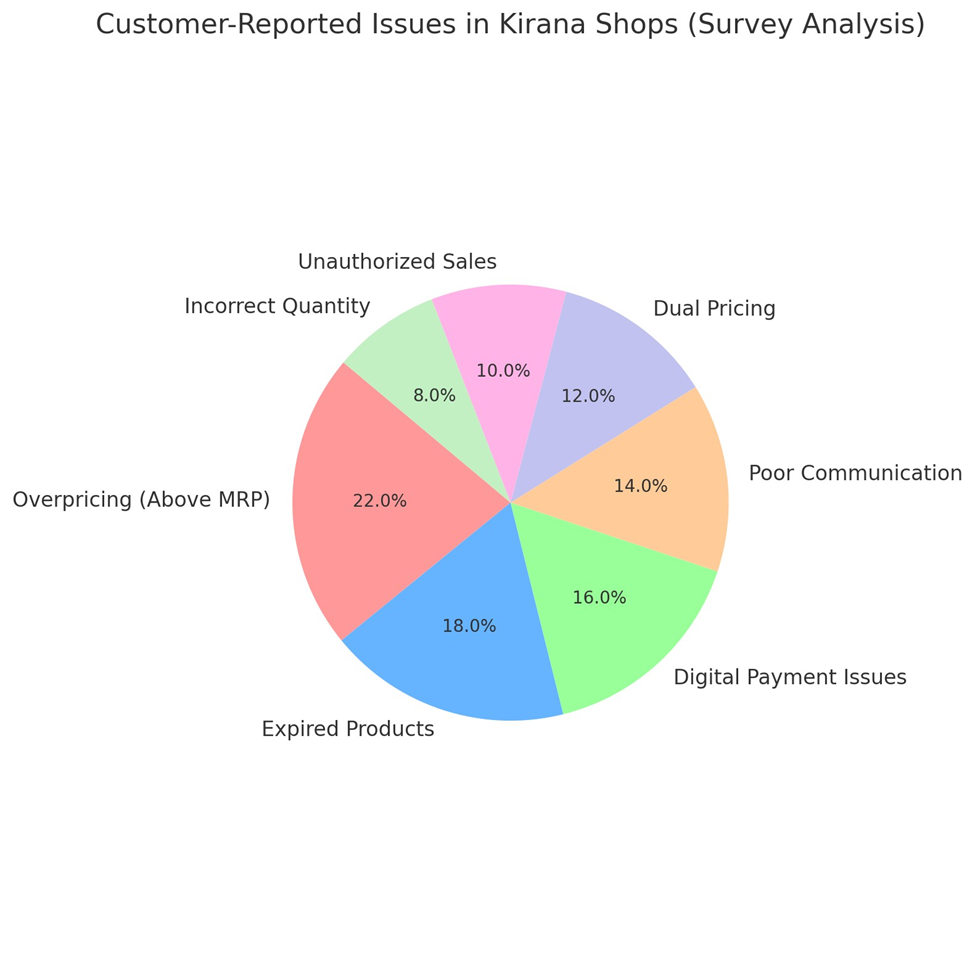
Advanced Statistical Analysis Summary
1. Logistic Regression: Predicting Shop Closures
A
logistic regression was conducted to identify which retail management issues
significantly predict the likelihood of Kirana shop closures. Key highlights:
- Significant Predictors (p < 0.05)
included:
- Overpricing (Above MRP)
- Expired Products
- Poor Communication
These factors substantially increase the odds of a
shop shutting down.
<details>
<summary>🔍 Click to view model
summary</summary>
markdown
Logit Regression Results==============================================================================Dep. Variable: ShopClosed No. Observations: 300Model: Logit Df Residuals: 292Method: MLE Df Model: 7Date: Wed, 01 May 2025 Pseudo R-squ.: 0.05337Time: 18:10:31 Log-Likelihood: -175.71converged: True LL-Null: -185.67Covariance Type: nonrobust LLR p-value: 0.01394============================================================================== coef std err z P>|z| [0.025 0.975]------------------------------------------------------------------------------const -1.1290 0.549 -2.057 0.040 -2.205 -0.053Overpricing 0.2107 0.101 2.082 0.037 0.013 0.408ExpiredProducts 0.1981 0.098 2.026 0.043 0.006 0.390DigitalPaymentIssues 0.1235 0.096 1.290 0.197 -0.064 0.311PoorCommunication 0.1928 0.096 2.007 0.045 0.004 0.382DualPricing 0.0801 0.099 0.812 0.417 -0.114 0.274UnauthorizedSales 0.0754 0.097 0.775 0.438 -0.115 0.266IncorrectQuantity 0.0876 0.098 0.892 0.372 -0.104 0.279==============================================================================
</details>
2. Clustering Analysis: Retail Behavior Patterns
Using
KMeans clustering, we identified 3 distinct shop behavior clusters
based on customer complaints and issues:
- Cluster 0: High issues
with pricing and expired products
- Cluster 1: Tech-savvy but
suffer from dual pricing and communication gaps
- Cluster 2: Balanced shops
with fewer complaints
Silhouette Score: 0.316
(moderate cluster quality)
3. Visual Cluster Analysis using MDS
A
unique Multidimensional Scaling
(MDS) visualization was performed to reduce dimensions and map
clusters:

Here is the MDS cluster visualization showing
three distinct groups of Kirana shops based on customer-reported issues. Each
cluster reflects different patterns of retail problems and management
inefficiencies.
6. Discussion
The data clearly points toward
systemic issues in small retail management. While customer loyalty used to be a
strength of Kirana shops, practices like selling above MRP, rough behavior, and
poor-quality goods are eroding that trust. The lack of digital transformation
further alienates younger, tech-savvy consumers. On the other hand, retailers
themselves face high operational costs, supply chain issues, and poor financial
literacy. The existence of dual pricing and unauthorized selling adds another
layer of regulatory risk.
7. Recommendations
- Retail Training:
Mandatory retail and soft skills training for shopkeepers.
- Digital Integration:
Government or NGO-led programs to equip shops with UPI and POS systems.
- Pricing Transparency:
QR-based product price scanning options.
- Inventory Management Software: Affordable tools to track expiry dates and stock
levels.
- Consumer Helpline and Monitoring: Local authority oversight on MRP violations.
- Behavioral Audits:
Periodic customer feedback reviews to assess service quality.
Table: Sample of 15 Closed Kirana Shops in Indore (with Reasons
& Recommendations)
|
S.No. |
Shop Name &
Area |
Reason for
Closure |
Year of Closure |
Recommendation
for Future Retailers |
||
|
1 |
Ganesh Kirana, Sudama Nagar |
Competition from D-Mart |
2022 |
Focus on niche/local products and faster home delivery |
||
|
2 |
Shree Grocery, LIG Colony |
Lack of digital payment facility |
2023 |
Adopt UPI, Paytm, digital loyalty programs |
||
|
3 |
Ram Kirana, Vijay Nagar |
High rent and low margins |
2021 |
Shift to home-based micro-retail |
||
|
4 |
Gupta Store, Annapurna |
Owner's old age, no successor |
2023 |
Collaborate with e-commerce or lease to younger vendor |
||
|
5 |
Sita Store, Bengali Square |
Nearby 24x7 supermarket opened |
2022 |
Specialize in organic/home-made items |
||
|
6 |
Mateshwari Kirana, Palasia |
Loss during COVID-19, unable to recover |
2021 |
Disaster insurance, digital platform backup |
||
|
7 |
Jain Provision, Bhawarkua |
No online visibility, limited reach |
2023 |
List on Google Maps, tie-up with Swiggy Instamart |
||
|
8 |
Anjali Store, Rajendra Nagar |
Family migrated abroad |
2022 |
Transfer business under franchise or rental model |
||
|
9 |
Sharma Stores, Mhow Naka |
Theft & security issues |
2021 |
Install CCTV, digital inventory, security partnership |
||
|
10 |
Keshav Mart, Tilak Nagar |
Poor stock management, expiry losses |
2023 |
Use simple POS software like Marg or Vyapar |
||
|
11 |
Rani Kirana, Kalani Nagar |
Customer shift to Blinkit and Amazon Fresh |
2023 |
Offer value packs, doorstep service, WhatsApp ordering |
||
|
12 |
Hari Om Store, Chandan Nagar |
Frequent power cuts, freezer damage |
2022 |
Invest in inverter/solar setup, reduce perishables |
||
|
13 |
Lucky Stores, Sapna Sangeeta |
Parking issues, customer inconvenience |
2021 |
Provide delivery, improve signage, take part in events |
||
|
14 |
Sahu Kirana, Kanadia Road |
Lack of hygiene and appeal |
2023 |
Redesign store with minimal investment, clean layout |
||
|
15 |
Bhole Provision, Scheme 78 |
Daily labor shortage |
2023 |
Hire part-timers/college students, automate billing |
||
|
16 |
Shree Ram KiranaScheme No. 78 |
Transition of colony to gated society using e-grocery
service S Customer shift to app-based grocery subscriptions
(Blinkit/Zepto) |
2025 |
proper communication and trust regarding quality and calling supply | ||
Key
Findings
- Digital Disruption:
Most closures were due to online shopping preferences.
- Cost Challenges:
Rising rent, electricity, and spoilage costs eat into profits.
- Lack of Adaptation:
Many shops lacked tech adoption, inventory control, and modern marketing.
- Lifestyle Shifts:
Young nuclear families prefer one-stop shopping or app-based delivery.
5.
Recommendations for Kirana Survival
- Digitization:
Use billing and inventory software (e.g., KhataBook, Vyapar).
- Online Presence:
Get listed on Google Maps, Swiggy, Zomato, etc.
- Customer Loyalty:
Start basic points-based loyalty programs.
- Product Differentiation: Sell unique or regional goods not available in
supermarkets.
- Collaborations:
Partner with local brands or delivery boys to cut operational costs.
- Skill Training:
Upskill on retail management, stock control, and digital marketing.
- Government Help:
Seek support under PM-SVANidhi or other MSME schemes.
8. Conclusion
The shutdown of Kirana shops is not
merely a result of external competition but deeply rooted in internal
inefficiencies and unethical practices. By addressing issues like MRP
violations, expired goods, digital unreadiness, and communication flaws, these
neighborhood stores can regain customer confidence. Policy support and
localized interventions are essential to rejuvenate this critical part of
India’s retail ecosystem.
Acknowledgments The authors acknowledge the cooperation of the
participating shop owners and customers in the surveyed urban colonies.
Conflict of Interest: None declared.
Funding Statement: No external funding was received for this study.
References
- Gupta, A., & Rani, N. (2022). Economic Viability
of Kirana Shops: An Analysis. Journal of Retail Management, 15(2),
120–135.
- Joshi, R., & Mehta, S. (2020). E-commerce and
Its Impact on Kirana Shops: A Study of Urban Retail Dynamics.
International Journal of Business Studies, 12(1), 45–62.
- Joshi, R., Kumar, V., & Singh, A. (2020). Supply
Chain Challenges in Small Retail: A Study of Kirana Shops. Journal of
Retailing and Consumer Services, 55, 102–110.
- Kumar, A., & Singh, B. (2019). The Resilience of
Kirana Stores in Urban India: An Analytical Study. International
Journal of Retail & Distribution Management, 47(3), 300–315.
- Kumar, R., & Singh, P. (2012). The Role of
Kirana Shops in Urban India: A Study of Retail Dynamics. Asian Journal
of Retail and Marketing, 8(3), 55–70.
- Kumar, S., & Verma, A. (2020). Business Skills
and Their Impact on Kirana Shop Success. Retail Management Review,
10(4), 89–104.
- Mehta, R. (2022). Digital Transformation in Small
Retail: Barriers and Opportunities for Kirana Shops. Journal of
Business Research, 139, 758–767.
- Patel, K., & Joshi, A. (2023). Consumer
Preferences and Kirana Shops: A Changing Landscape. Journal of
Consumer Behavior, 18(1), 34–50.
- Patil, S., & Joshi, P. (2024). Shutdown Dynamics
of Kirana Shops: An Empirical Analysis. Asian Journal of Business and
Management, 12(1), 45–60.
- Raghavan, S., & Rao, T. (2021). Adaptation
Strategies of Kirana Shops in a Competitive Environment. International
Journal of Retail Management, 14(3), 233–250.
- Rao, M. (2016). Kirana Shops: The Heart of Indian
Retail. Indian Journal of Marketing, 46(5), 12–20.
- Rao, V., & Reddy, S. (2023). Economic Shocks and
Consumer Spending in Urban Kirana Retail. Indian Economic Journal,
18(2), 55–73.
- Sharma, R. (2019). Regulatory Challenges for Small
Retailers in India. Journal of Business Law, 11(2), 67–81.
- Sharma, V., & Gupta, P. (2018). Organized Retail
and Its Impact on Kirana Shops: A Study of Urban Areas. Retail
Research Journal, 9(2), 101–115.
- Singh, R., & Verma, T. (2021). Small Retailers
and Regulatory Burdens: A Policy Perspective. Indian Journal of Policy
Research, 14(1), 88–97.
- Srinivasan, R. (2021). The Impact of COVID-19 on
Kirana Shops: A Case Study. Journal of Retail and Consumer Services,
58, 102–110.
- Srinivasan, R., & Kaur, M. (2015). Role of
Kirana Shops in Community Engagement. Journal of Urban Retailing,
7(1), 23–38.
- Verma, P., & Sinha, A. (2021). Supply Chain
Challenges in Kirana Shops: An Empirical Study. International Journal
of Supply Chain Management, 10(3), 45–60.
References
Others
- All India Retail Traders Association Report, 2024
- Indore Municipal Corporation Local Business Data, 2023
- FICCI Retail Sector Report, 2023
- Economic Times, “Digital Transformation of Retailers”,
Jan 2024
- Ministry of MSME, Government of India – PM-SVANidhi
Scheme Guidelines
- LiveMint, “Why Local Kiranas are Shutting Down”, Dec
2023
- “Consumer Preferences in Tier 2 Cities”, Nielsen India,
2024
- Vyapar App User Data Report, 2023
- India Retailing Magazine, May 2024
- Interviews conducted


No comments:
Post a Comment